
A Tired Pessimist
The Rise and Fall of Andrew Stoddart
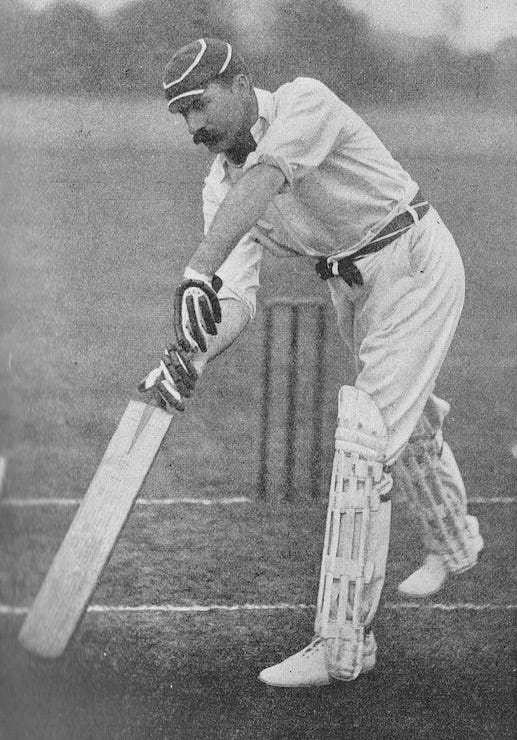
On New Year’s Day 1898, England began a Test against Australia at Melbourne, the second game in a five-match series. But the captain, Andrew Stoddart, did not care. Since 8 December, he had effectively withdrawn from the team. That was the date he had received a telegram informing him of his mother’s death.
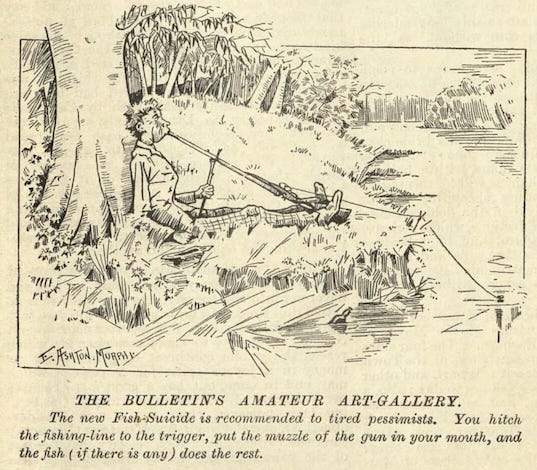
During the Test, Stoddart bought The Bulletin, the issue dated 1 January. One cartoon caught his eye enough that he cut it out and added it to his tour scrapbook.
It showed a bedraggled man sitting against a tree next to a river with the barrel of a rifle in his mouth. One end of a piece of string was attached to the trigger, the other to a fishing float in the water. The caption read: “The new Fish-Suicide is recommended to tired pessimists.” Everything else in the scrapbook either concerned cricket or consisted of newspaper clippings showing women’s portraits.
England lost the Test match.
Three years earlier, on 1 March 1895 at the same ground, Stoddart had been greeted by a cheering crowd after his England team won the final Test match by six wickets.
Stoddart’s side was missing many leading players, who were unwilling or unable to tour. Nor was it overflowing with options: of the thirteen players, two were wicket-keepers and another was an underarm lob bowler.
But the team had won the first two Tests. Australia had won the next two, leaving the series to be decided before 100,000 spectators across five days. Stoddart’s men prevailed. In the pavilion afterwards, the Governor of Victoria, Lord Hopetoun, gave a speech in which he praised Stoddart’s “consummate tact and sportsmanlike conduct” during the tour.
Stoddart kept a scrapbook of that tour too; cricket cuttings and photographs of women clipped from society pages.
As the team prepared to return home, Stoddart gave speeches that said all the right things. He did so back in England too, where his team were celebrated enthusiastically. But the glory was Stoddart’s. He had proven tactically astute despite little experience of captaincy, and he had contributed with the bat, not least an uncharacteristically slow but match-winning 173 in the second Test (“Well, I had to buck up for England, Home and Beauty”).
Perhaps his greatest achievement had been to charm the home crowds with his friendly modesty. He was by then a sporting idol. The Australian Tom McKibbin, who had grabbed the ball when the winning runs were hit in the final Test, agreed to give it to Stoddart as a memento in exchange for a photograph of the England captain.
It was the highest point of his career. Adored by crowds, admired by peers, celebrated in newspapers. Even Punch joined in, printing a celebratory verse which included the lines:
Then wrote the queen of England
Whose hand is blessed by God
I must do something handsome
For my dear victorious Stod.
No-one could get enough of Andrew Ernest Stoddart.
Stoddart’s first taste of captaincy had also come in Australia, albeit in a different sport. In late 1888, he was a key member of a rugby team touring Australia and New Zealand, one of the most brilliant players in England. A fast three-quarters, capable of bursts of pace and feats of try-scoring, he had already represented England. He could also kick with impressive accuracy, producing improbable drop-goals at a time when they outscored everything else.
The tour had been organised by Alfred Shaw and Arthur Shrewsbury, a pair of professional cricketers from Nottinghamshire. Despite the unofficial — and entrepreneurial — nature of the tour, Shaw and Shrewsbury’s team was retrospectively recognised as the first British Lions rugby team.
Stoddart had been in Australia since October 1887 because Shaw and Shrewsbury had preceded their rugby tour with a cricket one. When that concluded, Stoddart stayed behind and waited for his rugby team-mates.
The captain of the British side was the 29-year-old Robert Seddon. In August 1888, accompanied by Stoddart and another member of the team called Jack Anderton, Seddon had travelled up the Hunter River in Maitland, New South Wales. They planned some relaxation including rowing and swimming, while the rest of the team went ahead to Newcastle. Seddon left Stoddart and Anderton relaxing on a punt while he went further up the river, sculling on an outrigger.
Soon after, a boy came running to tell Stoddart and Anderton that a man was drowning in the river. They went to look for him and found Seddon dead half-a-mile away, his outrigger overturned. No satisfactory explanation for the accident ever emerged.
Stoddart took over the captaincy in what must have been very difficult circumstances. He played 28 games and scored 73 points. When the rugby tour ended, he had been away from home for more than a year. But it had not been a successful visit. Shaw and Shrewsbury lost money on their venture, even after arranging games of Australian Rules Football to make up the financial shortfall.
Yet there were rumours that Shaw and Shrewsbury had paid Stoddart £200 for taking part. As an amateur, it would have been acceptable for Stoddart to claim expenses, but not such a large amount of money.
In any case, the tour was not quite the highlight of Stoddart’s rugby career. He played ten matches for England, making his debut against Wales in 1885 and captaining the team four times in 1890. But he somehow never quite made a success of the role. And there were question marks over his ability too. Yes, he was fast, but his defence was suspect. In the biggest games, his kicking sometimes wilted under pressure. At international level, he scored just one try. Style over substance, perhaps?
As his cricket career flourished, Stoddart played less rugby. And the ending was abrupt. Recalled to the England team to play Scotland in 1893, he was an abject failure. The press were unsparing in their criticism. One journalist wrote in September 1893 that because of the negative reaction, Stoddart “will not don the football jersey again.”
On 4 August 1886, already a famous rugby player, Stoddart walked out to open the batting for Hampstead Cricket Club on their home ground. He had joined the club the previous summer, when he had also begun to play first-class cricket for Middlesex. For this particular one-day game, the opposition were “The Stoics”.
Stoddart had spent the previous night dancing with friends. At midnight, he joined a poker game. He won money and so kept playing. They did not stop until dawn. The group spent some time at the swimming baths before they ate breakfast. Only then, Stoddart headed to the Hampstead ground. And at 11:30am, he began his innings.
Just over six hours later, he returned to the pavilion having scored 485 runs. He had set a new record for the highest individual innings in an official cricket match. He celebrated by playing a tennis match immediately after before heading to a supper party. He finally went to bed around three in the morning.
News travelled fast, and his achievement was widely acclaimed. No-one seemed too concerned by the weakness of the opposition. Nor the unsporting way in which Hampstead batted all day to score 813 for nine without allowing the Stoics any time at the crease. While the apologists might have muttered that there was little option — declarations were not possible at the time — it would have been easy for Hampstead batters to have thrown their wickets away to allow the opposition to bat.
Instead, all the focus was on giving Stoddart time to break the previous record of 419. An odd approach to a friendly cricket match played among amateurs. The praise Stoddart received was out of all proportion to the achievement. Even so, his 485 marked his arrival as a serious cricketer. Nine days later, playing for Middlesex, he scored his maiden first-class century.
Ten years after his 485, Stoddart walked out to open the batting for England in a Test match at Lord’s, for the first game of a three-Test series. His partner was the England captain W. G. Grace, the most famous cricketer of all.
The two men had previously formed an effective first-wicket partnership, but in the summer of 1896 Grace was past his best and Stoddart was not quite in form. By then, Stoddart was viewed to be just as good as “The Champion”. He was one of the most respected, well-known faces in English cricket.
Without question, he was also one of the finest batters. For most of the 1890s, he was close to the top of the first-class run-scoring lists. When he was in form, he scored quickly and few could play strokes quite as attractively. As his Wisden obituary put it: “Again and again he proved his greatness by his ability to make runs under conditions which found other batsmen at fault, his play, both on fiery and on soft wickets, being quite exceptional.” Amateurs did not generally bat so well in unfavourable conditions.
For an English cricketer, there was no greater stage than a home Test match. But Stoddart was strangely shy about his place on it. When he walked out with Grace at Lord’s in 1896, he was playing only his fourth Test in England. Just over three weeks later, he played a fifth (and last) at Old Trafford.
It would have been more had he not twice turned down an invitation in 1890. He preferred to play for Middlesex. It had been a slightly odd decision, even at a time when Test matches lacked some of the prestige they later accumulated. It was a weak Australian team and a one-sided series, but cricketers — especially amateurs — did not turn down such an honour. Except Stoddart.
It was doubly puzzling because Stoddart, more than most amateurs, had something to prove.
Stoddart’s father was a colliery owner from the North East. In itself, such a background was enough for the cricket establishment to wrinkle their noses. But there was more. Although Stoddart was born in South Shields in 1863, the family moved south to London when he was nine. He attended St John’s Wood School, nominally a preparatory school — aiming to prepare its pupils for a public school like Eton or Harrow — but Stoddart never made that step.
There is no obvious explanation. Stoddart’s father was wealthy, but sent neither of his two sons to a prestigious school. Perhaps such things were not important to Stoddart senior, a businessman who made his fortune from running a wine-and-spirit shop. But when Stoddart made his way into the cricket world, or into wider London “society”, the absence of an “old school tie” would have kept doors closed. Almost every other amateur cricketer of his acquaintance had been to public school and Oxford or Cambridge. Not Stoddart.
Nor could he have asked his father for the reasons, because he died of tuberculosis in 1882, leaving an estate worth over £77,000. Stoddart’s mother was left enough to live comfortably, and moved in with her married daughter in Coventry. Stoddart remained close to her. Perhaps too much so.
Even when he was an established cricketer, his circumstances never quite matched the glamorous public figure. On both the 1891 and 1901 censuses, he was a boarder; not in a lodging house occupied by wealthy businessmen but with the family of a draper’s assistant in 1891 and the family of a clerk in 1901.
But if Stoddart lacked the required social background, he made up some of the deficit through pure sporting talent. He worked as a stockbroker, earning enough money to live comfortably. But he chose to do considerably more than that.
The 24 hours surrounding his famous 485 for Hampstead were not an outlier. Stoddart was a man who enjoyed himself. A “masher”: a young man about town, attending theatres and music halls, dressed to impress and with a keen eye for women. No-one was quite sure how he afforded such a lifestyle on what Australian newspapers — keen watchers of Stoddart on his four tours there — estimated was an annual income of between £500 and £600.
While he followed amateur conventions, such as shooting, he was always the outsider looking in.
And after all, he had never gone to public school, had he?
W. G. Grace was similarly an outsider, but his talent and outrageous self-confidence carried the cricketing world with him. Stoddart was far less sure of himself, had far too much to prove, at least in his own mind. Any criticism drove him inwards. And towards the end of the 1896 season, he was unwittingly drawn into a huge scandal.
Before the final Test against Australia, played at the Oval, five English professionals effectively threatened to strike unless they received a pay increase. Their central grievance was that the amateur members of the side received more in expenses than the professionals received in wages. Nor was this a new complaint.
In theory, an amateur was not paid to play cricket. Expenses were acceptable up to a point, as long as the player was not making a profit. But it was an open secret that many nominal amateurs received surreptitious payments to allow them to maintain their status. The most notorious example was Stoddart’s opening partner. One later estimate put Grace’s earnings from cricket at £120,000. Everyone turned a blind eye. After all, it was W. G. and he was the Champion. Where would cricket have been without him?
In the build-up to the final Test, newspapers were full of stories about the strike. One of the amateurs singled out in sections of the press sympathetic to the strikers was Stoddart. Although the five professionals backed down before the Test began, the damage had been done. On the morning of the game, Grace and Stoddart arrived at the Oval and complained bitterly to the Surrey authorities about the negative publicity that surrounded them. Surrey put out a statement to deny that Grace had ever received payments for playing at the Oval. About Stoddart, there was nothing.
And so Stoddart pulled out of the match, claiming to be suffering from a cold. No-one believed him, at the time or since. In later years, he went to some lengths to defend himself in print from the charge of making money from cricket.
Other amateurs who were similarly accused generally shrugged off the criticism. After all, their pedigree was not in doubt because of their public school background. And Grace knew that cricket needed him. Stoddart did not have that security.
A modern reader might wonder why he did not simply turn professional. But amateurism was about far more than payments: it was about class. To become a professional would have forfeited membership of the middle class.
No self-respecting amateur in the 1890s would even have countenanced such a thing.
Stoddart had played less often in 1897, struggling with injury and perhaps injured pride. He had already agreed to take another English team to Australia over the winter of 1897–98. Everyone hoped for a repeat of three years earlier, whether that was the visitors dreaming of another glorious win or the hosts imagining lucrative gate receipts.
Yet the lingering rumours about payments would not leave Stoddart alone. Newspaper reports speculated that he was to receive £1,000 for taking part in the tour. Years later, he vehemently denied receiving anything more than an expenses allowance for any of his visits to Australia.
Although Stoddart again struggled to convince leading players to join him, he was able to take two of the best amateur batters in England, Archie MacLaren and Ranjitsinhji, as well as several very good professional bowlers such as J. T. Hearne and Johnny Briggs. On paper, it was a stronger team than had triumphed 3–2 three years earlier. And England won the first Test in brilliant fashion. But at Melbourne, they lost comprehensively.
Not that too much praise or blame could have been apportioned to Stoddart. Just under a week before the series began, he received that telegram. Heartbroken at his mother’s death, he vanished from sight. He kept to hotel rooms and the confines of the dressing room. The captaincy he left to MacLaren. Stoddart was nothing but an observer for a month. But he kept reading the newspapers. And cutting out items that caught his eye for his scrapbook, including, occasionally, cartoons.
When Stoddart returned for the third and fourth Tests, he batted down the order and could do nothing to arrest the decline. Australia won both to build an insurmountable lead in the series. Stoddart offered his congratulations and then withdrew from the final Test. That was lost too, making it 4–1 to Australia. He played just once more, in the last match of the tour. One belated piece of good fortune: he won £1,350 in a sweepstake after drawing the name of a successful horse at a race meeting.1
But his anger and frustration poured out. First in letters home — criticising a “ridiculous” hat worn by Johnny Briggs; complaining about what he saw as a poor welcome when the team visited Tasmania — and then in several newspaper interviews in which he lashed out at what he considered to be the hostile Australian crowds that had continually barracked his team. The “jeering and hooting” had bothered him deeply, and he bitterly listed a string of incidents during the tour. He even criticised the press. And he returned to his theme at a dinner after the fifth Test.
The reaction among the Australian press and public was highly critical of Stoddart for being too “sensitive”. If one or two might have normally conceded he had a point about crowd hostility — it was a perennial complaint from English touring teams — neither his tone nor his timing, after a 4–1 loss, were designed to attract much sympathy. The team returned home branded failures both in England and Australia, and Stoddart’s popularity in Australia was considerably diminished.
By then, perhaps he no longer cared.2
There was not much cricket left. He played enough in 1898 to score over a thousand first-class runs at a very good average, but declined the Middlesex captaincy at the end of the season and announced his retirement from first-class cricket. There were a few more appearances. His last game for Middlesex was J. T. Hearne’s benefit match in June 1900. Stoddart made 221, his highest first-class score.
He continued to play for Hampstead until 1903, when a lack of fitness and some old injuries effectively ended his cricket career, other than a brief return to the field in 1907. Instead, he devoted himself to golf, at which he quickly became proficient. He accepted a position as secretary of Neasden Golf Club and proved a capable coach of its members.
And, finally, the “masher” settled down and married.
During each of Stoddart’s visits to Australia, he — along with other amateurs — was often the subject of speculation about his “eligibility” and romantic prospects in the pages of gossip columns. In his Cricket Captains of England (1979), Alan Gibson wrote about how, during that bleak second Test in January 1898, Stoddart “watched the match from a high window in the pavilion, ogled by the girls below.” Various women were rumoured to be the object of his affection.
The most revealing rumour was published in January 1898, best paraphrased by Gibson: “It was widely suggested for the rest of this Australian summer that [Stoddart] was looking for a wife: ‘Whose wife?’ was one mordant reply.”3
Perhaps inevitably, the woman Stoddart married was Australian. Several of his amateur contemporaries found their partners in Australia, including Archie MacLaren who met his future wife during Stoddart’s 1894–95 tour and married her there in 1898. But Stoddart went about it a little differently.
Many newspapers noted how, days before his marriage in October 1906, Stoddart had been appointed as the secretary to the Queen’s Club in West London. They also carried brief reports of his wedding. Strangely, almost all of them omitted any mention of his wife. Instead they described how, on the morning of the ceremony, he had played a foursome on Neasden Golf Course with his best man,4 the vicar and the church organist.
The event itself, held at St Stephen the Martyr’s Church in Hampstead on 27 October, was deliberately low-key, with little advance publicity (although the Hampstead News said that the church was “well-filled”). Modesty, perhaps. That too might explain the strange reticence to name his bride.
More likely, the couple feared a scandal if too much information emerged. Even the marriage certificate concealed some important details.
Stoddart had married a woman who called herself Ethel Luckham (she later added a middle name, Elizabeth) and claimed to be a 34-year-old widow. Her father, she said, was the deceased Theodore von Sinnebach. Several of those details were incorrect. The biggest fabrication was that she was a widow. She was actually a divorcee. If that had been known, she would not have been permitted to marry in a church.
She had first married a journalist called Robert Luckham in Sydney in December 1892. The register recorded her as Emelie Sinnbeck, born around 1869 (making her four years older than she claimed when she married Stoddart) in Rosedale, a town in Victoria around 100 miles from Melbourne.5 The couple lived in the Manly district of Sydney. But not for long.
In 1898, Luckham sent his wife to Wiesbaden in Germany to “consult an eye specialist”, as he later put it. She never returned. In January 1901, she had written to him suggesting that he divorce her on the grounds of desertion and had accused him of treating her “shamefully” since she “first arrived in London”. He was not entirely surprised. When his wife had first left for Germany, a woman in Manly had warned him that she would never come back. Their divorce was finalised in February 1904.
The chronology of Mrs Luckham’s relationship with Stoddart is uncertain. David Frith, in his 1977 biography of Stoddart, suggested that they met during Stoddart’s first tour of Australia in 1887–88. Frith called her “gay, tempestuous and a good deal younger than [Stoddart]”. A local studies blog associated with Manly library suggested that she had been a popular singer who “left for Europe, supposedly for the good of her voice”. Few of these details are particularly rooted in fact. For example, when they married, Stoddart was only around ten years her senior. However, it is true that she organised concerts in Manly in the mid-1890s, during which she gave many successful recitations. Perhaps she met Stoddart at such a social event during one of his tours.6
She was clearly not lacking in confidence. Maybe not in ambition either. It is quite another matter whether she knew what she was taking on.
Stoddart and his wife moved first to St John’s Wood Road, then to Clifton Hill in Maida Vale. He sometimes talked cricket and went to Lord’s. He also drank whisky and put on weight. His job at the Queen’s Club brought in £300 and required little effort, but his finances became strained. There might also have been at least one bout of illness.
The outbreak of the First World War affected him badly. He became moody and withdrawn, even from Ethel, and before the end of 1914 he suffered a nervous breakdown that forced him to resign his job at the Queen’s Club. He also contracted influenza. A doctor recommended a voyage by sea, but it never happened. He consulted another doctor but there was no improvement and he was incapable of working. This exacerbated his financial situation because he had “lost his money through the war”. Or at least that is what he told his wife.
A friend of Ethel, Isabel Dalton, who had known Stoddart since 1908 and occasionally lived at their house, noted how “during the past year or two”, he had “been very moody and nervy, not very well.” Increasingly morose, he had told Ethel that he “would die in his sleep, that life was not worth living.” He had begun to forget things. And he had also become irritable, complaining that the rustling of his wife’s newspaper at the dining room table was “driving him mad”.
At home on the evening of 3 April 1915, Stoddart sat at the dining room table and in front of his startled wife, pulled a revolver out of his pocket. She had not known that he possessed one. He said: “I am tired of everything and am going to finish it.” She tried to take it from him without success, and he went to his room, where he laid it on another table. Ethel persuaded him to get some sleep and then see some of his family the next day. As he was “very strange in his manner”, she let him keep the gun but only after checking it was unloaded and taking what she thought was his only box of ammunition.
Ethel then went downstairs to the drawing room, where Isabel Dalton was waiting. Just before midnight, Ethel decided she should try to retrieve the revolver. When she returned to the room, she found Stoddart lying dead in bed: he had shot himself through the cheek. No one had heard anything. A search revealed a concealed second box of ammunition. A doctor was summoned, and the police. But there was nothing to be done.7
A postmortem indicated that Stoddart had been suffering from severe pneumonia, which the doctor — who had played rugby with Stoddart years before — would have “upset the brain” and made him “despondent”. He thought Stoddart “must have felt very ill”.
An inquest concluded that he was a “temperate” man who had not been a drug-taker. Everyone said so, even the cook. Isabel Dalton added that he had “lived happily at home”; no-one had known he had a gun, nor thought he might kill himself. Ethel did not even believe he had life insurance. The verdict was clear: suicide while of unsound mind. He left an estate worth around £1,000, most of which was bequeathed to Ethel.8
Stoddart was cremated at Golders Green. The service was attended by several former cricketing colleagues. His ashes were taken to Coventry, where they were interred in his mother’s grave.
He was 52 years old. He had been a tired pessimist for a long time.
Contemporary reports said that he had also made money by wagering £10 with each of the professionals in his team that the same horse would not win the race; it came second, which was enough for the sweepstake and to win the bet. Stoddart shared at least some with the team: Australian reports said that he gave each professional a gift of £25 from his winnings, and in his Silence of the Heart, David Frith wrote that “he split [the prize] between his players and some of his hosts.”
It has been written several times, including by David Frith, that the poet Francis Thompson — who wrote “At Lord’s” — once described Stoddart as “that son of grief” after the 1897–98 tour. This was part of a review of A. E. Houseman’s A Shropshire Lad published in The Academy in October 1898 (the article was anonymous although there is no reason to doubt that it was written by Thompson). But the reference is actually a quote of a line from one poem “Twice a Week the Winter Thorough” which includes the lines “See the son of grief at cricket/Trying to be glad.” The writer asked: “Does Mr. Stoddart, that ‘Son of Grief,’ lead his men into the field, trying to be glad? And what price on his captainship, if he did?” Rather than identifying Stoddart as a man afflicted, the reference was merely to that of a contemporary cricketer in the context of the poem.
Although the actual article was less artistically put, it essentially made the same point: “It is said that Stoddart is on the look-out for a wife, but report doesn’t go any further and say whose wife.” It appeared in a column called “Society Gossip” by “A Society Lady”. The article can be read on the National Library of Australia website in the pages of the Molong Express (15 January 1898) but was presumably syndicated.
The best man was the Cambridge Blue and former captain of Blackheath Rugby Club, George Jeffrey, who had known Stoddart for many years.
The register listed her father as Peter Sinnbeck, a “gentleman”, not Theodore as she claimed in 1906.
Frith’s biography has been updated several times. This version comes from My Dear Victorious Stod (1977), which has always been the “definitive” work. The Manly library blog from 2014 is still viewable here. As for her musical career, Ethel might have sung at her wedding to Stoddart. The Hampstead News (1 November 1906) gave a garbled account of how “Miss Luckham” sang while the register was being signed. It had earlier called the bride “Mrs Luckham of Australia” and as it is unlikely any of her ex-husband’s relatives were present, this might have been a mis-transcription of her name.
His official date of death was 4 April 1915; his death must have been certified after midnight, but he was already dead on 3 April.
Ethel moved to New Guinea in 1924 but returned to England in 1938. Not long after, her property in New Guinea was destroyed in a volcanic eruption, leaving her in a precarious financial state and requiring an appeal among former friends of Stoddart to raise money for her. Frith tells a story that, having moved behind Lord’s Cricket Ground in 1948, she attended her first cricket match since 1915 and watched Don Bradman score a century. According to Frith, she remarked: “But Bradman can’t play rugby!” She died in 1950, leaving an estate worth just over £850. Her “official” age was 68, meaning that she must have shifted her birth year forward to 1882.