
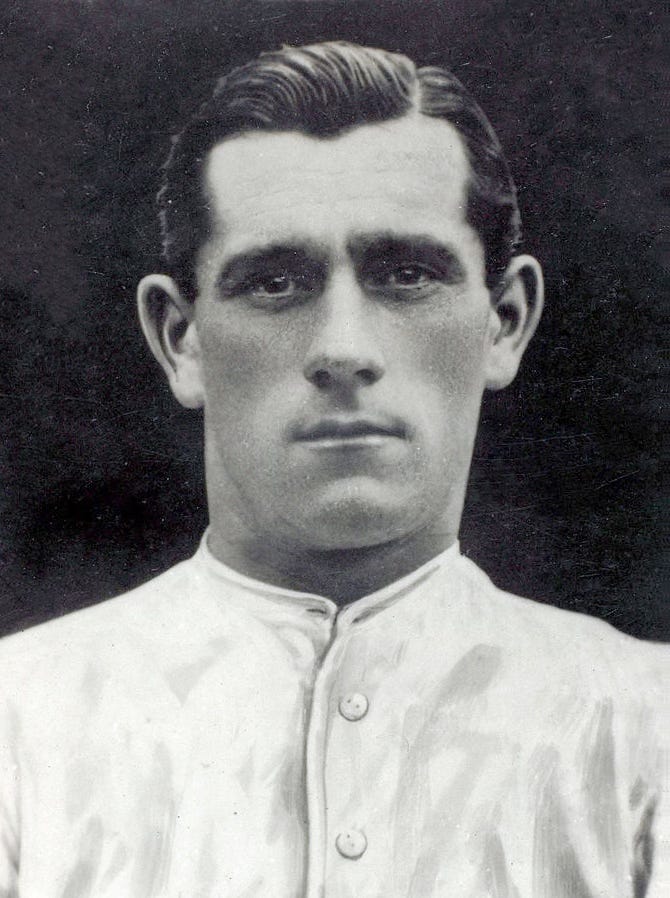

Few cricketers have fallen so far and so fast as Cecil Parkin, and those who have matched him usually had a reason, whether alcohol, drugs or mental health. Parkin achieved it entirely without assistance: self-sabotage driven by a need for validation.
Before the Fall, Parkin was a good professional cricketer. Born just outside the Yorkshire boundary, in Stockton-on-Tees, he played once for that county before anyone realised he was not qualified. With that avenue closed, he carved out a career in league cricket, and was in great demand in the Lancashire League. When he had qualified for Lancashire, having lived long enough in the county, he took fourteen wickets on debut in 1914 and was catapulted into representative cricket, appearing in Gentlemen v Players matches. After the war, he continued to represent Lancashire but played mainly in the Central Lancashire League. On his occasional appearances at county level, his quality was obvious and he played against the Gentlemen in 1919 and 1920. In fact, he was clearly among the best bowlers in England and when the legendary Sydney Barnes declined an invitation to tour Australia for the 1920–21 Ashes, Parkin was chosen as his replacement.
The similarities between Parkin and Barnes require a pause. Even today, many cricket followers are familiar with Barnes, whose Test record dwarfs almost all others and whose reputation has somehow endured for over a century while his contemporaries have faded from memory. If Parkin is remembered at all — and he usually isn’t — it is because of the Fall. But like Barnes, Parkin made his name in league cricket and spent much of his career outside the first-class game. And as a bowler, Parkin had modelled himself on Barnes to some extent. Both men bowled spin at medium-pace, a skill almost lost to modern cricket as it has been superseded by seam-bowling. On their day, both were unplayable; but Barnes had far more of those days than Parkin.
There were other differences. Where Barnes was metronomic and accurate, Parkin mixed up his bowling: in the stiffened atmosphere of the 1920s, he was seen as experimenting too much, over-reliant on his slower ball. Parkin also smiled more than Barnes. A renowned entertainer of the crowd, he even perfected tricks such as making the ball jump from his foot into his hand when he was fielding.
More importantly, Barnes was a stubborn, self-reliant man who knew his worth and deliberately turned his back on first-class cricket to carve out a career in the leagues where he was paid more for working less; Parkin was drawn to the brighter lights of the first-class game. And he lacked Barnes’ iron will and self-control. Whereas Barnes could walk calmly away if he was unsatisfied, Parkin reacted with fury.
One such incident arose in a Central Lancashire League match for Rochdale in 1920. It began with a rejected lbw appeal and ended with an entire club withdrawing from the league. Parkin, frustrated by what he saw as the umpire’s incompetence, stormed from the field during the game. His refusal to apologise — perhaps driven by local press suggestions that he might have had a point about the lbw decision — escalated to the point that the League Committee suspended him. Rochdale selected him anyway and in a faintly ridiculous dispute withdrew from the league, which insisted that it had already suspended the club.
That Rochdale were willing to go so far might indicate how good Parkin could have been; that such actions were necessary illustrates just as equally how impossible he became. Barnes would have left to find a better deal. Parkin needed to have the final word; he needed to be right and perhaps he even needed validation.
Two months later, a quiet compromise was agreed: Parkin expressed muted “regret” to Rochdale’s mayor and everyone carefully stepped back from the brink. Not that he was especially grateful for Rochdale’s support: the following season, the club suspended him for playing in a Gentlemen v Players match at the Oval without their permission, and when his contract expired at the end of the season, he chose not to renew it.
By then, Parkin was at his peak. He had already played nine Tests for England in 1920 and 1921; although his bowling returns were unremarkable, he was one of the better performers in a weak team. Having fallen out with Rochdale, he spent four seasons playing full-time for Lancashire, with considerable success. In that time, he had what he craved: applause, affection, adoration, the status of a county hero. But his satisfaction was fragile and his need to be right still lurked below the surface. When it erupted again, it brought about the Fall.
England’s next series at home was against South Africa in 1924. Parkin played in the first Test but bowled little as the England captain Arthur Gilligan and the seam bowler Maurice Tate demolished a weak opposition batting line-up in a comfortable win for the home side. Parkin went wicket-less and seems to have taken exception to how Gilligan overlooked him. He ill-advisedly expressed his displeasure at how Gilligan had used his bowling in his column, produced mainly by a ghost-writer, in the Sunday newspaper Empire News.
Under the inflammatory headline “Cecil Parkin Refuses to Play for England Again”, the article laid bare Parkin’s humiliation, the damage to his reputation he believed had been caused by Gilligan’. To complete the self-destruction, the article also directly criticised Gilligan’s captaincy. Parkin later insisted that the ghost-writer had over-reached, but these remarks were certainly in character. Even if it was just a post-match word uttered in fury, he had implied approval. And he had failed to check what appeared in his name.
Parkin received no support from the press (although Gilligan’s reluctance to use him attracted some comment). Instead, there was widespread shock that any cricketer, particularly a professional dependent on the backing of the establishment, would be so indiscreet or would dare to criticise the England captain so openly. The controversy echoed for some time and brought Parkin’s international career to a crashing end.
Parkin penned an apology to Gilligan and the Test authorities, but such attempts at damage limitation were doomed to failure and could not resurrect his international career. Nevertheless Gilligan held no lasting grudge: he even penned a forward to Parkin’s self-serving 1936 autobiography in which he blamed his ghost-writer for the incident. This defence is rather undermined by another unnecessary controversy during the winter of 1924–25, when the England team toured Australia under Gilligan’s captaincy.
Shortly before the third Test, when England were already 2–0 down in the Ashes, Parkin wrote an article for the Weekly Despatch that once again criticised Gilligan and called for his immediate replacement by the professional Jack Hobbs. This went far beyond wounded pride: it was deliberate heresy which attacked the whole system upon which English cricket was built. Leadership was the preserve of the amateur, of the “better” classes. Professionals were considered unsuitable and unworthy for captaincy. If the wider world increasingly challenged such snobbery, cricket was not quite ready for modernity. Even Parkin realised that such an action was unthinkable. As a compromise, he suggested another amateur, Percy Chapman, could take over from Gilligan.
This second piece brought down much more vehement condemnation from the establishment, including words from Yorkshire’s Lord Hawke that entered into infamy: “Pray God that no professional will ever captain England.” And the story travelled, being discussed widely in the press to the point that there was no hiding place. Parkin later lamented how he received abusive letters and criticism from spectators over his words.
The Fall was final, and there was no way back. His benefit match, given to him by Lancashire during the 1925 season, was impacted financially by his ill-judged article. And his on-field success was no compensation for the strife he caused Lancashire. The county quietly let him go in 1926, and he returned to play in the leagues, as well as running hotels and public houses.
Although Parkin maintained a newspaper column for many years, and was keen to opine on matters of the day, he had passed beyond relevance. For a man craving validation, it must have been a cruel blow and might explain why his autobiography included a foreword not just from Gilligan but also from a former Test selector, and why it tried so desperately to set the record straight. Parkin died from throat cancer in 1943, aged just 57, never having managed to do so.
Parkin’s model, Sydney Barnes, never worried about getting his views across or justifying himself. Although he was interviewed fairly regularly in old age, he had kept his counsel during his playing days. If he was unhappy, he took action but never rushed into print or clashed openly. He did not need validation because he knew his own worth; he did not court popularity but only pursued wickets. Anger was a private matter, dealt with out of sight. That was how he was able to turn his back on the establishment and yet still play for England; and why he was a legend long after his retirement.
Had Parkin absorbed those lessons, perhaps his career — and his life — could have been different.