
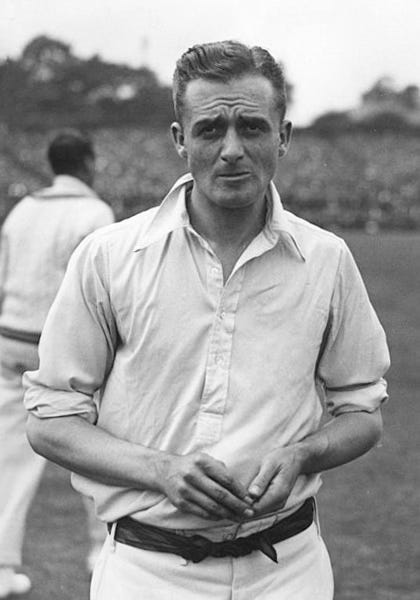

George Macaulay wasn’t keen to switch ends, but he respected the tactical genius of Wilfred Rhodes, so he ultimately agreed.
Playing at Bradford, Yorkshire were facing their first defeat of the 1925 season; Sussex needed 263 to win and just before lunch on the final day were 223 for three. Ted Bowley had already reached his century. The tired attack — featuring four Test bowlers, including Macaulay — had toiled all morning for one wicket.
Macaulay was in the middle of the greatest season of his career, one in which he took over 200 wickets, and enjoying a triumphant comeback after being overlooked for the previous winter’s Ashes series in Australia. His omission had not been based on cricket — he had headed the national bowling averages in 1924 — but on his behaviour.
He had a reputation as a fierce competitor who always had a sharp word for opponents, and equally so for team-mates. But occasionally he crossed a line that was fiercely demarcated in the 1920s: his hostility sometimes spilled into what today would be called sledging but which was frowned upon (especially from professionals) at the time. He was the bitter figurehead of a Yorkshire team that made itself very unpopular with its aggressive antagonism and hard-nosed professionalism; the team won many games but few friends.
Macaulay was a convenient scapegoat, but other changes followed. The ineffectual captain was replaced by another amiable amateur, Arthur Lupton, whose army background brought some discipline to the passionate team. Under his leadership, Macaulay exhibited more control, and thrived. So too the team.
But the strings were pulled by Rhodes, whose vast cricketing knowledge was always appreciated by Macaulay. And he probably admired the hard edge to Rhodes’s play, which contrasted with the softness of the game as played by “gentlemen” amateurs like Lupton, or the Sussex captain Arthur Gilligan.
Ironically, Macaulay’s background — privately educated at the establishment today known as Barnard Castle School and with a promising career in banking that he abandoned in his pursuit of professional cricket — would have made him an ideal amateur at many counties, perhaps enticed by a sinecure administrative position. Not at Yorkshire. And not for Macaulay. He didn’t compromise.
Inevitably, Rhodes’s instincts about the change of ends were sound and Macaulay bowled George Cox to bring about an early lunch. Sussex doubtless enjoyed their refreshments, needing forty runs to win with six wickets in hand. As for Macaulay …
Later stories stated that he drank champagne during the break. At the time, it was viewed as a restorative for fast bowlers. But for Macaulay, maybe it was something else because he had a long and troubled relationship with alcohol. His father, the landlord of a public house in Thirsk, had died at the age of 42 (when Macaulay was eleven), most likely through the effects of alcoholism. A story later told by Percy Fender indicated that when Macaulay toured South Africa with an England team in 1922–23, the amateur Arthur Carr encouraged him to drink heavily. And by the early 1930s, possibly sooner, Macaulay himself was an alcoholic, an illness that cost him his career and eventually his life. If the champagne story is true, was it a tonic? Or drowning sorrows in the face of defeat?
But when the teams came back out, something had changed. Macaulay was simply unplayable. He was never an easy bowler to face, always attacking, never offering a moment’s peace. He swung the new ball at a lively pace, but was more dangerous bowling brisk off-spin with rings of close fielders. Batters were often left guessing by his wide variety of deliveries — dubbed “Macaulay’s Essays” by one literate team-mate — but on that August afternoon, he was on another level.
In 32 deliveries after lunch, he took five wickets for eight runs. He swung the ball both ways and found alarming bounce from the pitch. Sussex were all out for 239; Yorkshire won by 23 runs and remained unbeaten for the remainder of the season. Macaulay had to sprint off the field to escape the ecstatic Yorkshire supporters but was left shattered by the mental and physical effort. Or perhaps by the champagne.
It was the kind of effort that Yorkshire bowlers pulled out; Roy Kilner had achieved something similar against Surrey in 1923. But with Macaulay, this was his entire mode of being. He never gave up.
He showed similar determination off the field. During the First World War, Macaulay had joined the Royal Field Artillery almost immediately after turning eighteen and was involved in fierce fighting on the Western Front. Kilner, Arthur Dolphin and Abe Waddington had fought too; such shared experiences formed a close bond between the three and probably with Macaulay too, although he was more on the periphery of that trio, who called themselves “the Three Musketeers”. However, Macaulay had not made it to the war’s end. In 1917, he had been seriously wounded in the leg and invalided back to England for a long and painful rehabilitation. But by sheer force of will, he recovered to become a cricketer.
Such single-mindedness made him a valuable bowler but could cause problems.
Because aside from his issues with alcohol, Macaulay was “fiercely independent” (as R. C. Robertson-Glasgow described him). His marriage to Edith Hay — one of the nurses who had looked after him during his long recovery from that injury — was unconventional, taking place within months of his release from hospital; neither family apparently approved because neither attended the wedding. Nor were his tastes conventional: a great lover of music — with a beautiful singing voice, a large record collection and a fondness for Gilbert and Sullivan — he often attended musical events at the Queen’s Hall when Yorkshire played in London.
Perhaps this is why he was respected by several surprising figures. When condemning his behaviour in 1924, Pelham Warner conceded that he was a “pleasant fellow” off the field; the journalist Dudley Carew called him a “grand friend” and Robertson-Glasgow wrote that he was “a glorious opponent; a great cricketer; and a companion in a thousand”.
These contradictions baffled his Yorkshire team-mates: Bill Bowes wrote how he never really knew Macaulay despite playing alongside him for years. But Robertson-Glasgow summarised him best: “Witty, argumentative, swift to joy and anger. He had pleasure in cracking a convention or cursing an enemy ... A cricket-bag came between him and his blazer hanging on a peg; and he'd kick it and tell it a truth or two, then laugh.”
But it was not always so amiable. The problems increased as Macaulay’s career went into decline, precipitated by a disastrous performance for England in the Headingley Test of 1926. Questions had already been asked about his effectiveness away from the Yorkshire team, and they were brutally answered when he came under heavy assault from Charlie Macartney, who scored a century before lunch on the first day. Macaulay crumbled and even a match-saving innings of 76 was no compensation. His Test career — which had begun with a wicket first ball against South Africa in 1922–23 — was effectively over.
After this, he was never quite the same player. Cause and effect become blurred, but alcohol certainly played a part. Nothing quite held together. His isolation in the Yorkshire team grew as his fellow war veterans left the stage; first his batting then his bowling fell apart. Plagued by an increasing number of injuries, he lost effectiveness and apparently interest.
It was his benefit match that pushed him over the edge: the practice of awarding professionals the proceeds of one match as a reward for long-service. Macaulay’s was held in 1931 but was fractious from the moment the Yorkshire Committee agreed to it. He never gave up, you see. Endless negotiations over the terms, collections withheld as punishment for his intransigence, a poor financial return, his stubborn refusal to accept Yorkshire’s standard practice of investing two-thirds of the amount on his behalf. Yorkshire judged the money to be theirs; he disagreed and spent it anyway. And then they stopped him. His drinking increased in response.
The end was messy. A brief return to his best for the 1933 season proved to be illusory and the next two seasons were largely lost to a succession of mysterious injuries. Yorkshire finally lost patience and informed him that he was no longer required. A sad final act followed: an attempt to market a quack cure for rheumatism, failed business ventures, bankruptcy, a reluctant return to professional cricket in the leagues. And more drinking, because he never gave up.
He died in disgrace, the circumstances known but kept hidden in Yorkshire circles. When the Second World War broke out, he joined the Royal Air Force as a catering officer and was stationed on Sullom Voe in Shetland. In December 1940, he engaged in a marathon drinking session; discovered unconscious in his quarters, he was taken to the sick bay and died suddenly a few days later. Owing to the manner of his death, his wife — who had stuck with him throughout the ups and downs — was deprived of a war pension.
Maybe such an end was inevitable for Macaulay. But it cost him a legacy and his memory evaporated into an embarrassed silence. In the end, he was not vanquished by a cricketing opponent, but by an unwinnable battle against his own demons and disappointments.
Note: For those wanting to know more, my biography of Macaulay, The Road to Sullom Voe, can still be found in a few places.