
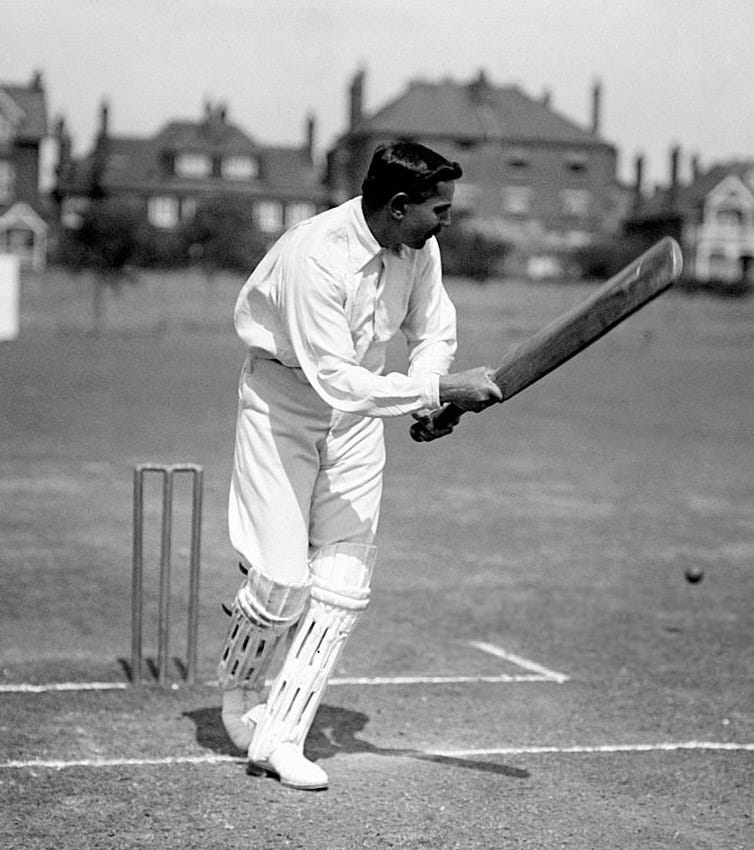
Even a spectator who had somehow never heard of Ranjitsinhji would have had no difficulty picking him out on a cricket field. Most obviously, he would almost always have been the only non-white player. But it was more than that. Rather than the usual coarse cricket flannels, he wore loose silk shirts that billowed in the breeze and flowed as he moved. It made him appear fluid, different to other, more static batters.
In his earliest days in the mid-1890s, his slight figure appeared vulnerable, out of place at the crease. And when the seasoned professionals bowled, his stumps seemed horribly exposed. Then he did something extraordinary. He moved across to the off-side and whipped the ball almost from his stumps — so close that bowlers threw up their hands in expectation — to the leg-side boundary for four. It was unheard of to bat in such a way; no-one had played the leg-glance before Ranjitsinhji. To those who had never seen it before, it was uncanny.
Beyond his unusual appearance and miraculous shots, there was further mystique because everyone thought they were watching an Indian prince. His skills were clearly a product of the East: mystical, unusual, magical. To many, he was a conjurer. And Ranjitsinhji played on the association, knowing that it helped to paint the picture he wanted.
Because nothing was quite as it appeared.
It was not exactly a lie. The Maharaja of Nawanagar had briefly considered adopting Ranjitsinhji as the heir to his throne in the 1880s. But court politics moved on, Ranjitsinhji was quietly dropped and he was despatched to England to complete his education, with an allowance to compensate for being discarded.
At first Ranjitsinhji was bewildered, then upset. But that gradually gave way to rage at what he saw as an injustice. In the meantime, the English public assumed he was a prince; he did not correct them. And by then, he had proved himself as an exceptionally good cricketer. First at Cambridge University in 1893, then with Sussex.
Yet his success was not as effortless as he liked to claim: not a product of his princely status, nor arising from India itself, but the result of hard work. The leg-glance developed through constant practice, particularly at a time when he was not especially strong and lacked power in his shots. Instead, he used sublime timing.
Towards the end of the 1890s, he began to give serious thought to making a claim to the throne of Nawanagar, investigating possible legal avenues and sounding out influential supporters. And his cricket continued to develop. He expanded his strokeplay, becoming a powerful driver as he became physically stronger. As opponents tried to crowd the legside to stifle his scoring, he opened up the field in other directions. His batting philosophy: “Play back or drive”.
The results almost defied belief. In 1896, he surpassed the record first-class aggregate in a season set by W. G. Grace twenty years earlier: Ranjitsinhji’s 2,780 runs included ten centuries (equalling Grace). Two of those hundreds came on the same day (which had not been done before and never has since). Such brilliance demanded a place in the England team; the selectors grudgingly acquiesced, and he scored a breathtaking century on his Test debut. An even better one followed in Australia in 1897–98.
After missing the entire 1898 season — spent in India in pursuit of his claims to Nawanagar — he broke his own record in 1899 with 3,159 runs. And the following season, if he scored marginally fewer runs (3,065), he made a record-breaking eleven centuries and had a scarcely conceivable average of 87.57. His consistency was terrifying for opposition bowlers.
At that stage, Ranjitsinhji was viewed as the greatest batter to have played the game, and his scoring feats were unprecedented. Perhaps only Don Bradman ever had the same aura of inevitability as Ranjitsinhji at the turn of the century.
Not everyone appreciated it. There were grumbles when he played for England, and some of the cricket establishment, including rarefied circles within the MCC, sneered at his achievements. Such attitudes were explicitly racist. But Ranjitsinhji was enormously popular with the general public.
In itself, that caused problems because he was expected to behave like a prince. Doing so was expensive, and Ranjitsinhji’s only income was an allowance from Nawanagar, which was halted when he made a claim to the throne. He had some rich supporters, but eventually the money ran out.
He carried on spending it anyway.
Ranjitsinhji’s personal life was similarly tangled. From the early 1890s, he was in a long-lasting relationship with Edith Borissow, the daughter of his former tutor in Cambridge. They became engaged — formally or otherwise — sometime after 1900. He was very close to her family, and when they moved to East Gilling in Yorkshire after her father’s retirement, he was a regular guest.
There is also a strong possibility that the pair had a child together in 1897, who was given up for adoption in Bradford immediately after his birth. The story emerged in 2014 but was apparently known to Ranjitsinhji’s cricketing acquaintances for many years.
In the mid-1890s, Ranjitsinhji also had some kind of relationship — possibly mild flirting by letter, possibly considerably more — with a Cambridge woman called Mary Holmes and her younger sister Minnie.1 He was corresponding affectionately with both sisters while Edith Borissow was probably carrying his child.
But for all three women, there were insurmountable obstacles to any serious relationship. Aside from casual racism and grave concerns in England about the wisdom of “mixed” marriages, Ranjitsinhji was not expected to remain in England. Nawanagar increasingly consumed him. And as time passed, there was a further mark against his name as far as any prospective in-laws were concerned.
He was on the brink of financial scandal.
Ranjitsinhji was almost declared bankrupt in 1902, which was probably why he failed so dismally in that summer’s Ashes series, scoring 19 runs in four innings before being dropped. Nor did his money worries ever quite go away; he disappeared from England after the 1904 season as he tried to appease creditors in India. Further debts awaited payment back in England.
By then, his best cricketing days were behind him. Although he still achieved high scores, he never regained the same heights as his best years. Instead, most of his focus shifted to what he saw as his rightful claim to the throne of Nawanagar.
Then an opportunity arose out of nowhere. The Maharaja of Nawanagar — the 24-year-old Jassaji,2 who had succeeded to the throne as a minor in 1895 — died suddenly in August 1906. He had been in apparently excellent health. And by a happy coincidence, Ranjitsinhji was in India at exactly the right time. No suspicions or accusations were ever committed to paper, but there might have been some knowing looks in the Nawanagar court.
With no heir in place, it was up to the British — who administered much of India and had enormous influence over the theoretically independent princely states — to choose a successor. The British-educated, familiar figure of Ranjitsinhji, who had been lobbying them for a decade, was their ideal choice. He offered stability that vastly overshadowed the flimsiness of his claims. And that was far more important than any lingering suspicions about exactly how Jassaji had died.
The fulfilment of all his ambitions did not bring the happiness of which Ranjitsinhji might once have dreamed. As ruler of Nawanagar, his hands were tied by the influence of the British and the financial limitations of a state that was in desperate need of modernisation. Nor could he simply go back to England and play cricket whenever he wanted. He was able to play for extended spells during the 1908 and 1912 seasons, but was a shadow of the batter he had once been.
And in 1908, there was enormous embarrassment about his profligate spending and refusal to pay bills, which resulted in several claims against him in court. He returned to Nawanagar in mild disgrace. While he concentrated on a life of luxury, administrators gradually improved the infrastructure and finances of Nawanagar, leading to some barely deserved praise for his achievements as maharaja.
His relationship with Edith Borissow continued, and she visited him regularly in India. He in return paid frequent calls at East Gilling when he was in England. Their engagement seems to have continued through this period, but was never likely to have ended in marriage. Although there were precedents for Indian princes marrying European women, these relationships had ended unhappily and were viewed unfavourably by the British authorities. Nor was Edith’s father ever likely to give permission, particularly after one of her brothers, who had worked for a time as a tea-planter in Bengal, had three children with an Indian woman.
During the First World War, Ranjitsinhji visited England regularly. In 1915, he was grouse-shooting on the North Yorkshire Moors with a group that included Edith. When he noticed a local man aiming rather wildly, he pushed her to safety but was struck by a wayward shot which left him blind in the right eye.3 For all his gallantry, such an injury while people were dying on the Western Front was an embarrassment.
Ranjitsinhji and Edith broke off their engagement after the war ended, but remained close for the rest of his life; in later years, she only ever spoke of him with kindness.
Ranjitsinhji never married, despite frequent suggestions that he would.4 Friends and family quietly suggested that he had suffered heartbreak involving an English woman. And he often presented an image of himself as a man who was shy and awkward around women or who could not marry because of a childhood betrothal in a religious ceremony. But this was a performance that concealed a very different reality.
Ranjitsinhji died in 1933 and was acclaimed as one of the greatest cricketers, the exemplar of the “Golden Age”. His personal legacy was more complicated, particularly as he grew increasingly bitter in his final years, resentful that he was not treated with more respect as ruler of Nawanagar, and resisting growing claims for Indian independence because of how the princes might be affected.
But as a cricketer? Even today he is not quite forgotten, not least because the domestic first-class competition in India is still named after him: the Ranji Trophy. And his statistics stand out. If most of his records were eventually eclipsed, his first-class batting average of 56.37 is still among the highest of all time.
More importantly, he showed what was possible: with his revolutionary leg-glance but even more so with his very presence. He showed that the greatest batter in the world — over several years — could be a non-white cricketer.
And, at the time of the British Empire and an assumption by imperial powers of white supremacy in all things, that was the most revolutionary idea of all.
Mary Holmes married in 1898; Minnie never did, a result, her family believed, of regret at the end of her relationship with Ranjitsinhji.
Jassaji was the son of Vibhaji, the maharaja who had considered adopting Ranjitsinhji. It had been Jassaji’s birth in 1882 that apparently ended Ranjitsinhji’s prospects of succeeding Vibhaji.
He briefly and unsuccessfully tried to resume first-class cricket with one eye, playing three games for Sussex in 1920.
Ranjitsinhji formed another relationship with a woman called Mrs Margaret Williams, who might have been his nurse in the 1920s, which was likely based on little more than companionship.